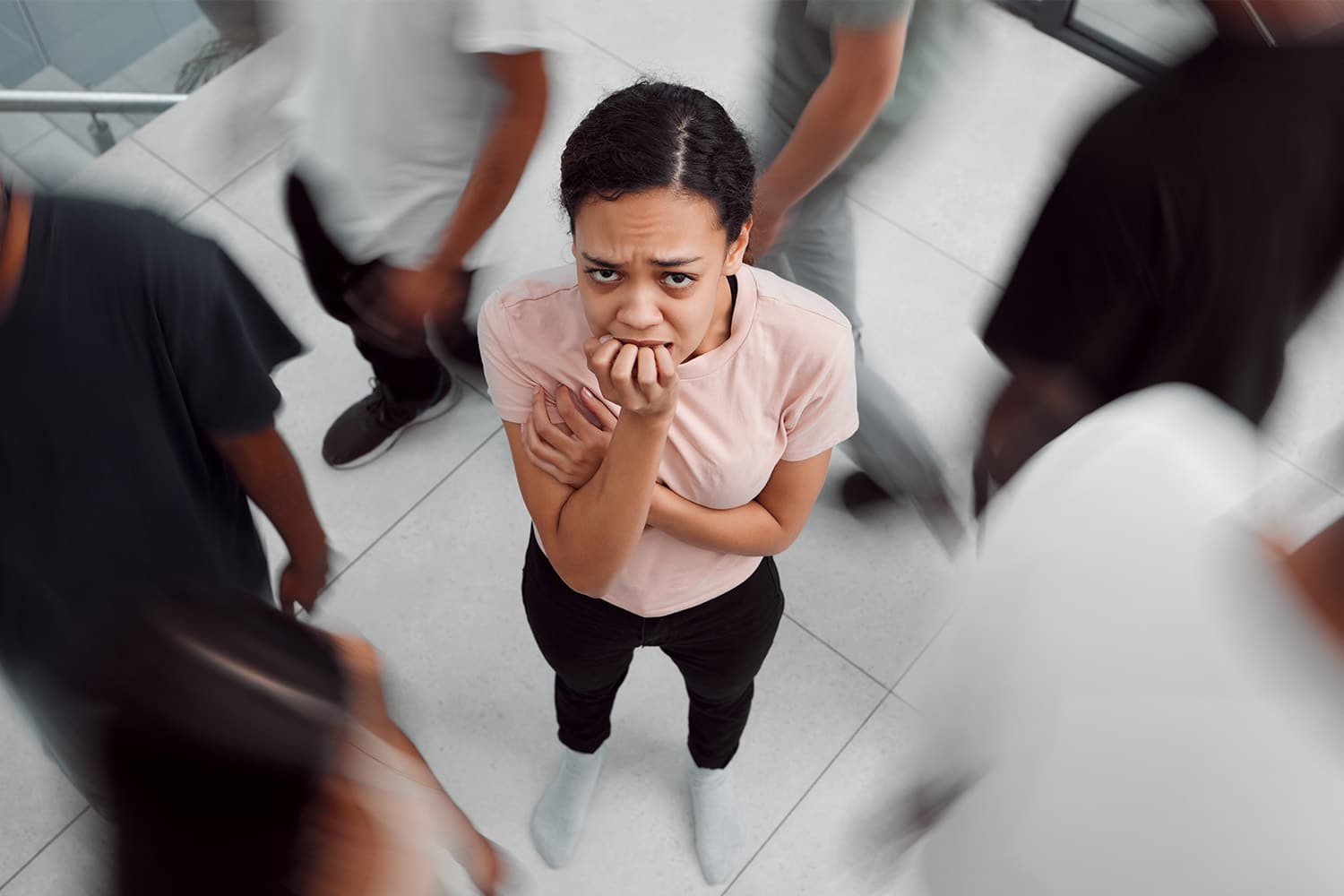

Masking in autism is a complex coping mechanism which many people on the higher functioning end of the spectrum engage in, usually setting in during early childhood.
This tends to happen when a child realises the way they’re acting isn’t helping them fit into their peer groups or fostering acceptance within friendship circles.
It’s a strategy of social acceptance. Because we are, after all, wired for connection.
And so, a child that may begin life as a uniquely bright and shining individual may eventually become a shapeshifter, dimming their light, denying themselves and beginning a process of masking their identity.
Conditioning themselves to conform. To be ‘normal.’
Because some of their quirkier, more outspoken, and direct ways just aren’t received in the way that they would like to by their peers.
Over time, this leads to the development of elaborate, social scripts and the manufacturing of an identity that the autistic individual feels the world wants to see from them.
But in reality, a greater portion of the world craves the uniqueness that highly functioning autistic and neurodivergent individuals have to offer.
There are many examples of famous people on the high functioning end of the autistic spectrum who’ve made massive contributions to culture, art, and the progression of society.
And this can largely be attributed to the eschewing of status quo and following the road less travelled.
However, when an autistic – or any neurodivergent – individual masks themselves, they deny the artistic, the expressive, the genius, the beauty that is them.
Over time, this can lead to emotional burnout, due to the extent of the masking and the emotional toll it takes to not be themselves.
Let’s drop the masks.
Masking in Autistic Adults: Understanding the True Cost
Aside from the obvious question of identity and authenticity, there is actually a greater psychological toll that masking within autistic individuals brings.
Think about it like this. The more you deny yourself, the more tension you are creating within.
Because that inner voice of authenticity will never go away. It simply finds another way to make itself heard. Oftentimes, in quite uncomfortable ways.
This can lead to a psychological and emotional burden, which can significantly impact the mental well being of an autistic individual. And it can be particularly true of high masking autistic women who develop very sophisticated camouflaging strategies.
If masking persists long enough, transitioning from childhood into adolescence and into adulthood, it can potentially lead to **autistic shutdowns** when the coping mechanism can’t manage the demands of trying to fit into a certain social circle or social context.
This can be understood through the concept of allostatic load, which in layman’s terms, represents the cumulative psychological burden that occurs when the body’s stress response systems – which, in part relates to the sympathetic nervous system – are continuously activated and are never at rest.
As a defensive mechanism, masking requires perpetual hypervigilance. Each social interaction involves complex translation – from receiving social cues to filtering them through one’s authentic self to producing appropriate responses.
This can be particularly challenging to navigate for people who experience both ADHD and ASD, where there can be increased demands on the cognitive load needed to restrain themselves in certain contexts.
It’s been observed that prolonged masking triggers elevated cortisol levels, which is the stress hormone within the human body. It’s been noted that the cortisol patterns experienced in autistic adults are remarkably similar to those non-autistic individuals who experience chronic stress.
This continued state of hyper-vigilance often creates a cascading or a compounding effect with autistic individuals who engage in masking, often reporting up to two and a half times higher the rates of stress related health conditions compared with their non autistic counterparts.
Autistic Burnout and Energy Depletion
And so what does this look like?
What does an autistic burnout that is the result of consistent masking actually look like?
Well, as we’ve said, it’s a combination of both cognitive and psychological factors which can often lead to shutdowns due to the demands of masking when they become overwhelming.
This can be thought of as masking-related anxiety which isn’t to be confused with OCD-like anxiety. In autism, masking-relating anxiety may present as compulsively checking and making preparations before a certain decision or activity is engaged with.
In autism, this is most often linked to keeping up appearances and maintaining social acceptance.
Whereas in OCD, this form of anxiety, which is rooted in repetitive behaviours, is focused on the fear of preventing specific outcomes.
Although the behavioural patterns may look similar on the surface, the mechanics and the way they manifest are actually very different.
Autistic adults typically experience severe energy depletion as a result of their masking behaviours, which can have significant impact on their quality of life.
As we’ve already touched on, this can lead to shutdowns when the allostatic load is simply too much to hold and can lead to an individual needing to take significant recovery time to recuperate.
This can be explained more fully through the metaphor of the cognitive battery.
If you imagine that each one of us has a certain amount of cognitive energy to expend throughout the course of the day, and if that battery is being drained far quicker than it can be replenished, it will lead to a lack of functionality.
This then makes it very difficult to engage in regular day to day activities that many other neurotypical people would take for granted.
Again, this ties back to the allostatic load and the constant state of hyper-vigilance, which while underlying and not outwardly manifested, still has an impact on the nervous system of a person with high masking autistm.
Identity Loss and Authenticity Struggles
It’s an easy assumption to make that masking might only take effect during social interactions, but there is actually a much deeper story to be told within the suppression of self.
We’ve already touched on just how much suppressing oneself through masking affects authenticity.
But consider this.
Even when high functioning autistic individuals who engage in high masking are alone, the masks can often remain in place, because the conditioning runs so deep.
For many people, the hypervigilance remains, which can lead to automatically – and oftentimes unconsciously – monitoring behaviours. Constantly auditing your thought patterns and roleplaying them in social scripting scenarios.
This creates a deficit in not only authenticity, but in feeling that inner sense of security, being able to let loose and just be as you are within your own home and your own environment.
In fact, it’s been noted that on average, most autistic adults develop between three to four distinct social personas that they use during masking.
These are often different versions of self that help navigate workplace commitments, romantic connections, family commitments, and day to day communications with the public.
However, again, all of this comes at a cost.
Because yes, of course, we can all have our phone voice, we can all have prescribed ways we act in certain situations. Social etiquette isn’t wholly a bad thing.
But if it comes at the cost of never truly being yourself and taking off some of these masks for the fear of not being received as we truly are, what kind of life is that?
Every time we speak, every time we act, and every time we choose, we are consciously – or unconsciously – voting for an identity.
And so, if there is a continued choosing of a certain identity through the wearing of a autistic mask, eventually through the brain’s capacity for neuroplasticity, the brain will rewire itself and embed that change.
Relationship Challenges and Social Exhaustion
When it comes to forming deeper connections and more meaningful relationships, there can often be an oxymoron at play in individuals with high masking autism. The closer you get to someone, the more distant you might end up feeling.
And this actually makes perfect sense, as it’s been found that autistic adults who mask consistently are far more likely to feel emotionally disconnected from those closest to them.
In this context, you could think of masking as an ‘intimacy barrier.’ And it can be an incredibly frustrating pattern. Just when you should feel at your most comfortable, the masking increases.
Relational closeness only serves to heighten it.
The protective barriers that usually dissolve the more people deepen into connection intensify, almost in protest at being seen, heard and felt.
And because of this, building trust takes much longer.
In fact, it may take up to 2 to 3 times longer for high masking autistic individuals than their neurotypical counterparts to feel safe enough to lower their masks.
And there’s no shame in that.
But this extended timeline creates its own unique challenge.
Because if you are consciously holding back your true self, this can create ‘disclosure stress,’ which can lead to the constant narrative of, “will they or won’t they like me as I really am?”
And of course, there is a gradual, revealing of the self in all intimate relationships. It’s just that when it comes to masking and autism, especially in high functioning individuals, there can be a sense of the hidden self, which is rarely shown if ever to anyone.
How Do You Know if You’re Masking Your Autism?
To understand whether you’re engaging in an expression of him, asking relating to your autism, it’s going to require an incredible amount of honesty.
No one wants to admit they’ve been living any kind of a lie. It can bring up a lot of shame, and regret of a life unlived.
There are many ways to begin the conversation with yourself.
The amount of techniques and strategies, journaling questions, and ways to engage in compassionate self-inquiry is huge. But in truth, one of the simplest things you can do is simply monitor how comfortable you feel in your own skin.
Are you constantly second-guessing yourself in social situations?
Are you constantly engaging in anxiety related scripting?
Are you holding back from saying the things that you really want to say in favour of a manufactured response?
Autism Masking Examples: Navigating the Workplace
Being an autistic person within a professional environment, which might not necessarily provide the accommodations which are necessary can be particularly challenging. Or, for example, in the case of someone might not be aware that they have autism, and therefore are unable to advocate for their needs.
The workplace can be a very unforgiving environment.
And it’s one of those social contexts more than any other, which relies on at least a moderate sense of acceptance in order to feel comfortable.
And then there’s the fact that so much of the progression within modern businesses doesn’t just rely on the quality of your work, but also is largely dependent on how well-liked someone is within the group.
And it’s this sense of underlying, oftentimes unspoken judgement, which can make masking within the workplace environment one of the most exhausting parts of high functioning autism.
There are so many complex and unwritten expectations to navigate that it can be overwhelming, trying to keep up with the demands.
Understanding Workplace Masking Patterns
- Daily Preparation Time: Up to 2 additional hours spent preparing for routine interactions
- Cognitive Resource Usage: Expending disproportionate amounts of daily mental energy to maintaining professional masks
- Script Maintenance: Maintain a detailed repertoire of conversation scripts for various scenarios
- Sensory Accommodation: Many individuals with high masking autism endure uncomfortable environments without seeking support
- Recovery Needs: Significant downtime required after workday masking
Common Masking Scenarios and Strategies
| Situation | Masking Behaviour | Impact |
| Team Meetings | Rehearsed contributions, practiced body language | Increased anxiety about unexpected questions |
| Break Room Chat | Prepared small talk scripts, monitored expressions | Mental exhaustion from sustained performance |
| Client Interactions | Carefully constructed professional persona | Stress from maintaining consistent presentation |
| Office Environment | Suppressing sensory discomfort | Physical strain and decreased productivity |
Real-World Examples
Morning Meeting Navigation
- Arriving 15 minutes early to mentally prepare
- Reviewing prepared responses for common questions
- Monitoring facial expressions and posture
- Managing sensory overwhelm from fluorescent lights and multiple conversations
Social Interaction Management
- Maintaining a catalog of appropriate workplace anecdotes
- Practicing “natural” reactions to colleagues’ stories
- Timing contributions to group discussions
- Creating scripts for common workplace scenarios
Professional Identity Challenges
Although it’s not uncommon for many people to experience being unable to express their authentic personality in the workplace, in high functioning autistic individuals, it can be particularly challenging leading to:
- Disconnection from authentic self
- Increased stress and anxiety
- Reduced job satisfaction
- Higher risk of burnout
- Difficulty maintaining consistent performance
Autism Masking Examples: Surviving the School Environment
For many people, whether they are neurodivergent or not, the school experience represents one of the earliest points of contact with people outside of their family unit where they might feel the need to be guarded to protect themselves.
School years are crucial in the development of the personality.
There is a tremendous amount of imprinting and conditioning, which can be created through overwhelming need to avoid isolation and find safety within the school tribe.
Perhaps most ironically, many autistic students achieve above-average academic results while experiencing significant internal turmoil.
This “success mask” often prevents educators and support systems from recognising the true extent of their struggles.
The pressure to maintain this academic performance while managing social demands creates a unique form of trauma, where achievement becomes linked with suppression of authentic self-expression.
Common Masking Scenarios and Responses
| Situation | Masking Strategy | Impact |
| Classroom Participation | Prepared responses, timing contributions | Mental fatigue |
| Group Work | Mimicking peer behaviours, scripted interactions | Social exhaustion |
| Teacher Interactions | Professional persona maintenance | Cognitive strain |
| Playground Social Time | Catalogued social scripts | Emotional depletion |
Key Masking Patterns
Academic Performance vs. Emotional Cost
- Above-average grades despite masking burden
- Higher achievement often masks internal struggles
- Significant emotional toll despite academic success
- Increased risk of burnout during high-stakes periods
Social Navigation Strategies
- Maintaining detailed response catalogues
- Developing situation-specific scripts
- Carefully timing social interactions
- Monitoring and adjusting body language
Autism Masking Examples: Family Gatherings and Social Events
Family gatherings and social events can be particularly challenging in terms of masking behaviours. And one of the main factors is the infrequency of contact with people who might only be interacted with a few times per year.
This can result in the maintaining outdated versions – and expectations – which autistic individuals might feel obliged to maintain in order to keep up appearances.
In fact, it’s not uncommon for there to be up to 5 to 6 well established masks with each one being carefully calibrated to a different person’s temperament and expectations.
This creates a huge amount of emotional labour, which can contribute to either showing too much of oneself, or even just remaining as quiet as possible.
Deep down, desiring to express what’s real, but then decided against it at the last minute, when the social scripts override authenticity.
Many autistic individuals report that their most sophisticated masking strategies were developed in response to family interactions, where the pressure to appear “normal” often came from well-meaning but misunderstanding relatives inadvertently suppressing their identity.
For example, this could manifest through the steering of conversations to different topics, which are deemed to be more, “appropriate for the dinner table.”
Key Masking Strategies
| Strategy Type | Description | Impact |
| Preparation Time | 3-4x longer than other events | Reduces unexpected situations |
| Mask Management | 5-6 distinct personas | Adapts to different family members |
| Emotional Monitoring | Every 30 seconds on average | Maintains expected social presence |
| Buffer Creation | Designated quiet spaces | 65% reduction in anxiety |
Essential Preparation Elements
- Creating detailed interaction scripts
- Establishing multiple escape routes
- Planning recovery periods
- Identifying safe spaces
- Developing structured activity plans
Real-World Examples
Before the Event:
- Rehearsing common family conversations
- Preparing responses to typical questions
- Mapping quiet areas for breaks
- Arranging transportation control
During the Event:
- Rotating between different family groups
- Taking scheduled sensory breaks
- Using structured activities as buffers
- Maintaining different communication styles with various relatives