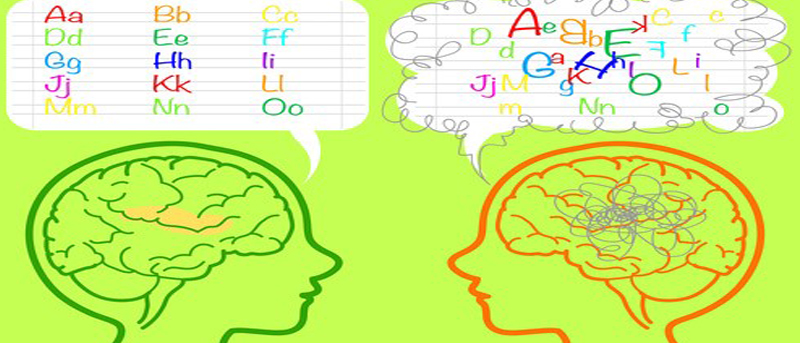

In my experience working with autistic adults, maths difficulties are one of those things that rarely gets talked about. People come in for an autism assessment, and somewhere in the conversation they mention, almost as an aside, that they’ve always been terrible with numbers. That budgeting feels impossible. That they still count on their fingers. That they’ve arranged their entire life around avoiding mental arithmetic.
What often surprises them is learning this might not just be “being bad at maths.” It could be dyscalculia.
Dyscalculia is a specific learning difficulty that affects how the brain processes numerical information. It’s separate from autism, but the two conditions overlap far more often than most people realise. And because autism tends to dominate clinical attention, dyscalculia frequently goes unrecognised.
If you’ve struggled with numbers your whole life and never understood why, a dyscalculia assessment could provide answers. Understanding whether dyscalculia is part of your profile changes how you approach practical challenges and what support might actually help.
What is Dyscalculia?
Dyscalculia is sometimes called “number dyslexia,” though this comparison only goes so far. Like dyslexia, it’s a neurodevelopmental condition that affects a specific domain of learning. But where dyslexia affects reading and written language, dyscalculia affects numerical processing.
People with dyscalculia often struggle with basic number sense. This includes things like estimating quantities at a glance, understanding what numbers actually represent, remembering arithmetic facts such as times tables, doing mental calculations, telling the time, managing money, and judging distances and durations.
The condition affects roughly 5 to 7 percent of the population. It’s present from childhood and persists into adulthood, though many adults have never heard of it and assume they’re simply “not a numbers person.”
It’s Not About Intelligence
Dyscalculia has nothing to do with overall intelligence, and many people with dyscalculia are highly capable in other areas. The difficulty is specific to how the brain processes numerical information, not a reflection of general cognitive ability.
This distinction matters because many autistic adults with undiagnosed dyscalculia have spent years feeling stupid or lazy when it comes to numbers, when actually they’re not. Their brains simply process numerical information differently to other people.
Is Dyscalculia a Form of Autism?
No. Dyscalculia and autism are separate conditions with different diagnostic criteria. Autism is characterised by differences in social communication and the presence of restricted interests and repetitive behaviours. Dyscalculia is a specific learning difficulty affecting numerical processing.
However, the two conditions can and do occur together. Autistic people appear more likely than the general population to have significant maths learning difficulties, and many clinicians suspect dyscalculia is under-recognised in this group.
The relationship works in both directions. Having one neurodevelopmental condition increases the likelihood of having others. Just as autism and ADHD frequently overlap, dyscalculia commonly co-occurs with autism, ADHD, and dyslexia. These conditions cluster together, likely due to shared genetic and neurological factors. This pattern of neurodivergent symptoms appearing together is something we see regularly in clinical practice.
What Does Science Say?
Research on dyscalculia specifically within autistic populations is surprisingly limited, particularly for adults. Most studies have focused on children and adolescents, and they often use the term “mathematics learning disability” rather than dyscalculia specifically. But what we do know is striking.
Elevated Rates in Autism
A 2016 study by Oswald and colleagues at UC Davis examined maths abilities in high-functioning adolescents with autism compared to IQ-matched controls. They found that 22 percent of the autistic group met criteria for a mathematics learning disability, compared to 0 percent of controls. This is roughly three times the rate found in the general population.
The same research team reviewed earlier studies showing that 17 to 40 percent of high-functioning children with autism have significantly lower mathematics achievement than would be predicted by their IQ. This pattern of specific maths difficulty within autism has been replicated across multiple studies.
Broad Maths Difficulties
More recent research by Tonizzi and Usai, published in 2024, found that autistic students scored lower across all tested maths domains compared to their peers. This included arithmetic facts, mental calculation, mathematical inferences, and word problem solving.
Interestingly, difficulties were particularly pronounced for complex tasks requiring conceptual understanding and flexible reasoning. Basic calculation was also affected, but the gap tended to widen for more cognitively demanding mathematical work.
Shared Cognitive Factors
Both conditions show associations with working memory difficulties and executive function challenges. Verbal working memory, visuospatial working memory, and inhibition all correlate with maths performance in autistic individuals. This suggests that domain-general cognitive factors, rather than a single “maths module” in the brain, contribute to the overlap.
Research has also identified potential genetic links. A genome-wide association study led by Simon Baron-Cohen found a chromosome region associated with both mathematical ability and increased risk for autism and learning difficulties. This is preliminary but suggests partly shared genetic influences.
What We Don’t Know
I should be clear about the limitations here. There are currently no robust population-based estimates of how many autistic adults specifically meet criteria for dyscalculia. Most research uses different definitions and focuses on children. The specific intersection of autism and dyscalculia in adults remains understudied.
What we can say confidently is that maths difficulties are common in autism, that they often go unrecognised, and that understanding them as potentially separate from autism itself can be helpful for finding the right support.
How Dyscalculia and Autism-Related Maths Difficulties Differ
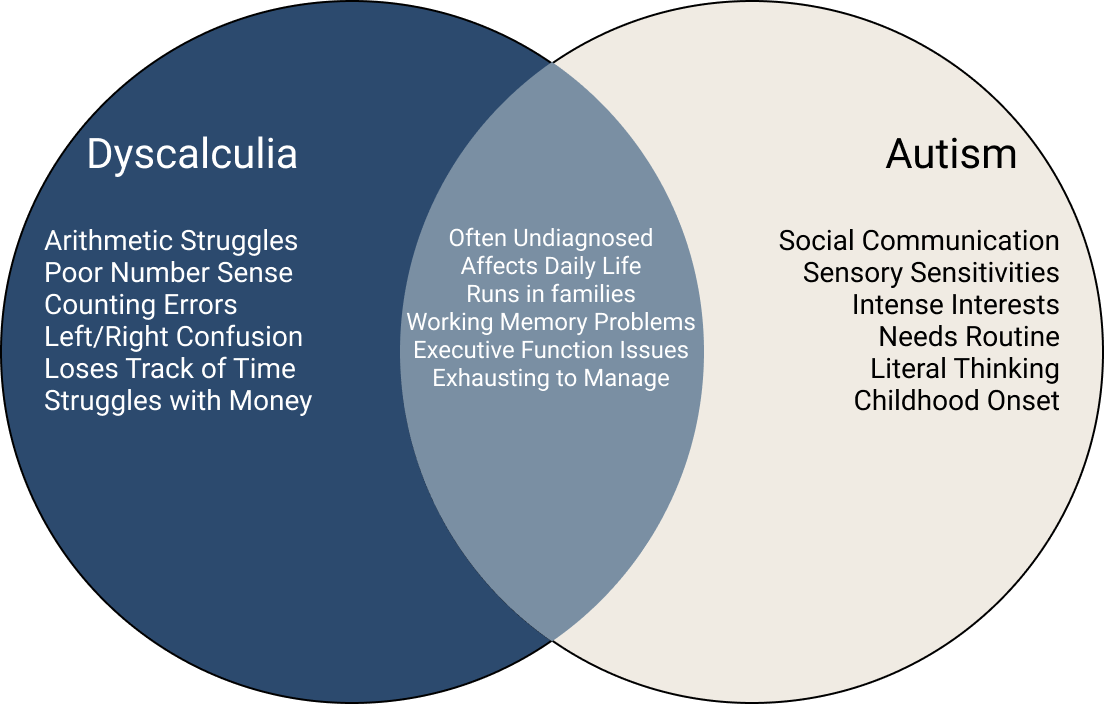 Dyscalculia and Autism Symptoms Venn Diagram
Not all math difficulties in autistic people are dyscalculia. Some stem from autism-related factors like language processing, anxiety, or executive function challenges rather than from core numerical processing problems.
Understanding the distinction can help clarify what kind of support might help.
| Feature | Dyscalculia | Autism-Related Maths Difficulties |
| Core difficulty | Basic number sense and arithmetic facts | Word problems, inference, flexible reasoning |
| Simple calculations | Consistently slow and error-prone | May be relatively intact, though often still below peers |
| Number magnitude | Often clearly impaired | May be relatively stronger than applied skills, but profiles vary |
| Times tables | Very hard to memorise despite practice | May be learnable with effort |
| Word problems | Difficulty due to numerical component | Difficulty due to language and inference demands |
| Pattern | Present from early childhood, resistant to instruction | More variable, may improve with accommodations |
In practice, many autistic people have a mixed profile where both factors play a role. The boundaries are not always clean cut, however, recognising whether difficulties are primarily numerical or primarily related to language, flexibility, and executive function can guide intervention.
Why Dyscalculia Gets Missed in Autistic People
Dyscalculia is underdiagnosed in the general population. In autistic people, it’s even more likely to go unrecognised.
Diagnostic Overshadowing
When someone has an autism diagnosis, there’s a tendency for all difficulties to be attributed to the autism. Maths struggles get explained away as “just part of autism” rather than investigated as a potentially separate condition.
This is sometimes appropriate. Autism can affect maths performance through multiple pathways. But when there’s a specific, persistent difficulty with basic numerical processing that doesn’t respond to typical accommodations, dyscalculia may be the missing piece.
Executive Function Confusion
Executive function difficulties are common in autism and can affect maths performance. Slow processing speed, working memory limitations, and difficulty with multi-step tasks all make arithmetic harder. But these are different from dyscalculia’s core difficulty with number sense itself.
Clinicians unfamiliar with dyscalculia may see slow, error-prone maths performance and attribute it to attention, anxiety, or autism-related executive function differences rather than investigating further.
Assessment Challenges
There are no autism-specific norms for dyscalculia screening tools. Standard assessments may not account for how autism affects test performance. An autistic person might score poorly on a math assessment for reasons related to the testing format, sensory environment, or anxiety rather than dyscalculia itself.
This makes assessment more complex and requires clinicians who understand both conditions.
The Masking Factor
Many autistic adults have become skilled at masking their difficulties, and this extends to dyscalculia. They develop workarounds: always using a calculator, avoiding jobs with numerical components, relying on partners for financial tasks, memorising specific calculations they need regularly. These compensatory strategies can hide the extent of the underlying difficulty from others and sometimes even from themselves.
Practical Impacts in Adults
For autistic adults, undiagnosed dyscalculia can create persistent difficulties that affect daily life in ways that aren’t always obvious. While most research on these impacts comes from dyscalculia studies in general adult populations, clinicians frequently observe similar patterns in autistic adults with maths difficulties.
Money Management
Budgeting, checking bank statements, calculating tips, comparing prices, understanding interest rates. All of these require numerical processing. When that processing is effortful and unreliable, financial management becomes stressful and often avoided.
This can lead to practical problems like overspending, difficulty saving, or avoiding financial decisions entirely. For autistic adults who may already find administrative tasks challenging, dyscalculia adds another layer of difficulty.
Time Perception
Dyscalculia often affects time estimation. How long will this task take? When do I need to leave to arrive on time? How much time has passed since I started?
Combined with autism-related difficulties with transitions and time management, this can create significant problems with punctuality, planning, and meeting deadlines.
Navigation
Spatial awareness and numerical estimation overlap in navigation. Judging distances, following numbered routes, estimating journey times. People with dyscalculia often struggle with these, which can limit independence and create anxiety around travel.
Employment
Many jobs require some numerical competence. Even roles that aren’t maths-focused may involve timesheets, expenses, data entry, or interpreting numerical information. Dyscalculia can narrow employment options or create hidden struggles in otherwise suitable jobs.
The Fatigue Factor
Like other neurodevelopmental differences, dyscalculia creates cognitive load. Tasks that neurotypical people handle automatically require conscious effort and attention. Over time, this contributes to the kind of exhaustion that can lead to autistic burnout. Understanding dyscalculia as a separate factor can help explain why certain tasks are so draining and inform better pacing strategies.
The ADHD Connection with Dyscalculia
Dyscalculia and ADHD frequently co-occur, with some studies suggesting elevated rates of overlap, though exact percentages vary depending on how both conditions are defined and measured. The shared involvement of working memory and attention in both conditions likely contributes to this pattern.
This creates a situation where autistic adults with ADHD traits may have multiple overlapping conditions affecting their maths abilities. Executive function difficulties from ADHD, autism-related language and flexibility challenges, and dyscalculia’s core numerical processing problems can all compound each other.
If you have both autism and ADHD, and you’ve always struggled with numbers, dyscalculia is worth considering as a separate factor. Understanding the full picture of how your brain works, including all the different presentations of ADHD, can help clarify which difficulties come from where.
Related Conditions
Dyscalculia rarely occurs in isolation. Other conditions to consider if you’re exploring maths difficulties include:
Dyslexia affects reading and language processing. It frequently co-occurs with dyscalculia, and the two conditions share some cognitive features including working memory involvement.
Dyspraxia affects motor coordination and spatial processing. There’s overlap with dyscalculia in spatial aspects of numerical understanding, such as judging quantities and understanding number lines.
ADHD affects attention, working memory, and executive function. Its impact on maths can look similar to dyscalculia, making differential assessment important.
There is Help Available
If you’ve spent years feeling like numbers simply don’t work the way they should for you, it can be a relief to learn there’s a reason. Dyscalculia isn’t a character flaw or a sign that you didn’t try hard enough at school. It’s a neurodevelopmental difference with a name, and understanding it opens doors.
Adults with dyscalculia develop strategies that work for them. Technology helps enormously: calculator apps, budgeting software that does the maths for you, visual timers, GPS navigation. Workplace accommodations are possible once you have a diagnosis to explain what you need. And simply knowing why numbers have always felt so hard can lift years of shame and self-blame.
Many of the autistic adults I work with describe their dyscalculia assessment as clarifying rather than limiting. It doesn’t create new problems. It explains existing ones. And explanation is the first step toward finding approaches that actually fit how your brain works.
How to Get Help and Next Steps
If you recognise yourself in this article, assessment can provide clarity. Understanding whether dyscalculia is part of your profile helps explain longstanding difficulties and opens up targeted support options.
Getting a comprehensive dyscalculia assessments by an educational psychologist who understands dyscalculia in the context of autism and other neurodevelopmental conditions is an excellent starting point.
If you’re also questioning whether you might be autistic, or if you have an autism diagnosis and want to understand how dyscalculia might fit into your broader profile, an autism assessment may be appropriate alongside or before a dyscalculia assessment.
If you’re unsure where to start, you can book a free 15-minute consultation to talk through your situation and explore which assessment pathway makes sense for you.