
In my clinical experience, questions about a possible link between autism and narcissism are becoming increasingly common. They usually come from people trying to make sense of challenging or confusing behaviour in themselves, or in their partners, colleagues, and family members.
In this article, I aim to break down this complex and frequently misunderstood topic, exploring where the confusion comes from, and what the psychological evidence actually tells us. At The Private Therapy Clinic, we regularly support individuals around these concerns, including offering specialist autism assessments and therapeutic support.
They Are Not the Same Thing
Before going further, it’s worth stating clearly: autism and narcissism are distinct conditions. Most autistic people are not narcissistic. Most narcissistic people are not autistic.
Research consistently shows that only 0% to 6.4% of autistic adults meet criteria for narcissistic personality disorder. These are separate developmental pathways that occasionally overlap but are far more often confused than genuinely co-occurring.
The confusion is common because certain autistic traits can look like narcissistic ones from outside. The person who talks at length about their interests without noticing your eyes glazing over. The partner who seems oblivious to your emotional state. The family member whose bluntness lands like cruelty. These presentations can feel similar to live with, even when their origins are entirely different.
A formal autism assessment can provide clarity when you’re caught in this uncertainty. In Ireland, the HSE does not currently provide autism assessments for adults, which means most people seeking answers will need to access a private assessment. But understanding the core differences yourself is a useful starting point, whether you’re trying to make sense of someone else’s behaviour or pushing back against a label that’s been unfairly applied to you.
Why Autism Gets Mistaken for Narcissism
Several autistic traits map onto what people expect narcissism to look like. This creates a pattern of misattribution that can persist for years before anyone questions it.
Apparent self-focus. When someone talks extensively about their special interests, struggles to pick up on conversational cues, or misses turn-taking in dialogue, it reads as self-absorption. The neurotypical interpretation is that this person doesn’t care about anyone but themselves. In autism, the reality is usually the opposite: the person cares deeply but lacks the intuitive social processing that would let them demonstrate that in expected ways.
Blunt communication. Autistic people often say exactly what they mean. In my clinical experience, this is one of the most common sources of conflict in relationships. They skip the softening language, the social lubricant, the white lies that smooth over difficult truths. To someone unfamiliar with autism, this directness can feel tactless, unkind, or deliberately provocative. The assumption is that they know how their words land and simply don’t care. More often, they genuinely don’t know.
Emotional dysregulation. Shutdowns, meltdowns, withdrawal under stress: these responses to overwhelm can look manipulative or rejecting to partners and family members who don’t understand what’s happening. When someone’s emotional responses seem out of proportion to the trigger, it’s easy to assume they’re using distress as a weapon rather than genuinely struggling to regulate.
Rigidity and rule-following. An insistence on things being done a certain way, a difficulty with compromise, a tendency to correct others: these patterns can feel controlling. They can look like the entitlement of someone who believes their way is the only right way. In autism, they often reflect a nervous system that finds deviation from routine genuinely distressing.
None of this is to say autistic people are incapable of difficult behaviour, or that autism excuses genuine unkindness. It’s that the motivation behind the behaviour matters enormously when you’re trying to understand what you’re dealing with.
The Empathy Question
This is the heart of the confusion. The stereotype of autism includes a lack of empathy. The defining feature of narcissism is a lack of empathy. If both conditions involve empathy deficits, how can they be different?
The answer is that “empathy” isn’t one thing.
Two Types of Empathy
Researchers distinguish between cognitive empathy, which is the ability to understand what someone else is thinking or feeling, and affective empathy, which is the capacity to share in those feelings, to be moved by another person’s emotional state.
Autistic people typically have intact or even heightened affective empathy. They feel deeply. Many describe being overwhelmed by others’ distress, absorbing emotions from those around them, caring intensely about suffering they witness. What they struggle with is cognitive empathy: reading unspoken cues, inferring mental states, predicting how others will respond. They feel with you. They just don’t always know what you’re feeling until you tell them directly.
Narcissism tends to show the opposite pattern. People with narcissistic personality disorder often have adequate cognitive empathy. They can read people. They know what you’re thinking. They’re often quite skilled at predicting responses, which is partly what makes manipulation possible. What they lack is affective empathy: the emotional resonance, the genuine care about another person’s inner experience. They understand you. They just don’t feel moved by that understanding.
Why This Distinction Matters for Relationships
This has profound implications. An autistic partner who doesn’t notice you’re upset will often be genuinely distressed once they realise, and will want to repair the situation. A narcissistic partner may notice exactly what you’re feeling and simply not care, or worse, use that knowledge against you.
The Double Empathy Problem
The double empathy problem, a concept developed by researcher Damian Milton, adds another layer. It suggests that empathy failures between autistic and neurotypical people run both ways. Neurotypical people struggle to understand autistic experience just as much as autistic people struggle to understand neurotypical expectations.
What gets labelled as an autistic person’s “empathy deficit” may often be a mutual misunderstanding in which neither party intuitively grasps the other’s perspective. It’s a communication mismatch, not a moral failing.
What Does the Research Say About Autism and Narcissism?
The scientific literature on this overlap is still developing, but several key findings are worth knowing.
Empathy Patterns in NPD
A 2011 study by Ritter and colleagues examined empathy in people with narcissistic personality disorder using the Multifaceted Empathy Test. They found that NPD patients had reduced emotional responses to evocative images but performed normally on theory of mind tasks. This supports the pattern described above: intact cognitive empathy, impaired affective empathy.
Empathy in Autism
Research by McKenzie and colleagues in 2022 looked at empathic accuracy in autistic young adults. Interestingly, they found no significant group differences in cognitive or affective empathy on objective measures, though autistic participants self-reported lower perspective-taking. This suggests that actual empathic capacity may be stronger than autistic people often believe about themselves.
Misdiagnosis Rates
Kentrou and colleagues published a 2024 study examining perceived misdiagnosis in autistic adults. They found that 31.7% of autistic women reported having received a prior psychiatric misdiagnosis, compared to 16.7% of autistic men. Personality disorders were among the most common mislabels. This gender disparity reflects broader patterns in how autism presents differently in women and how clinicians often miss it.
The Harm of Mislabelling
A UK study by Eccles and colleagues at Brighton and Sussex Medical School in 2024 documented what they called “harrowing experiences” among autistic women who had been misdiagnosed with borderline personality disorder. The parallels to narcissism misattribution are direct: autistic women described having their distress interpreted as manipulation, their sensory overwhelm read as dramatic behaviour, their authentic selves pathologised. The overlap between BPD and autism creates similar diagnostic confusion, particularly for women.
Vulnerable Narcissism and Autism
Research by Broglia and colleagues in 2024 examined narcissistic traits in autistic adults. They found that 28.7% of their sample of 87 autistic adults were at risk for pathological narcissism on screening measures.
However, this elevation was concentrated in vulnerable narcissistic traits, not grandiose ones, and appeared linked to social relatedness challenges rather than the entitlement and exploitation typical of NPD. The study authors suggest these elevated scores may reflect overlapping features like emotional dysregulation and social withdrawal rather than true comorbidity.
The Bottom Line From Research
True co-occurrence of autism and narcissistic personality disorder appears to be rare. Studies suggest categorical comorbidity rates between 0% and 6.4%. Most autistic people do not have NPD. Most people with NPD are not autistic. These are genuinely distinct conditions that occasionally share surface features.
How to Tell the Difference
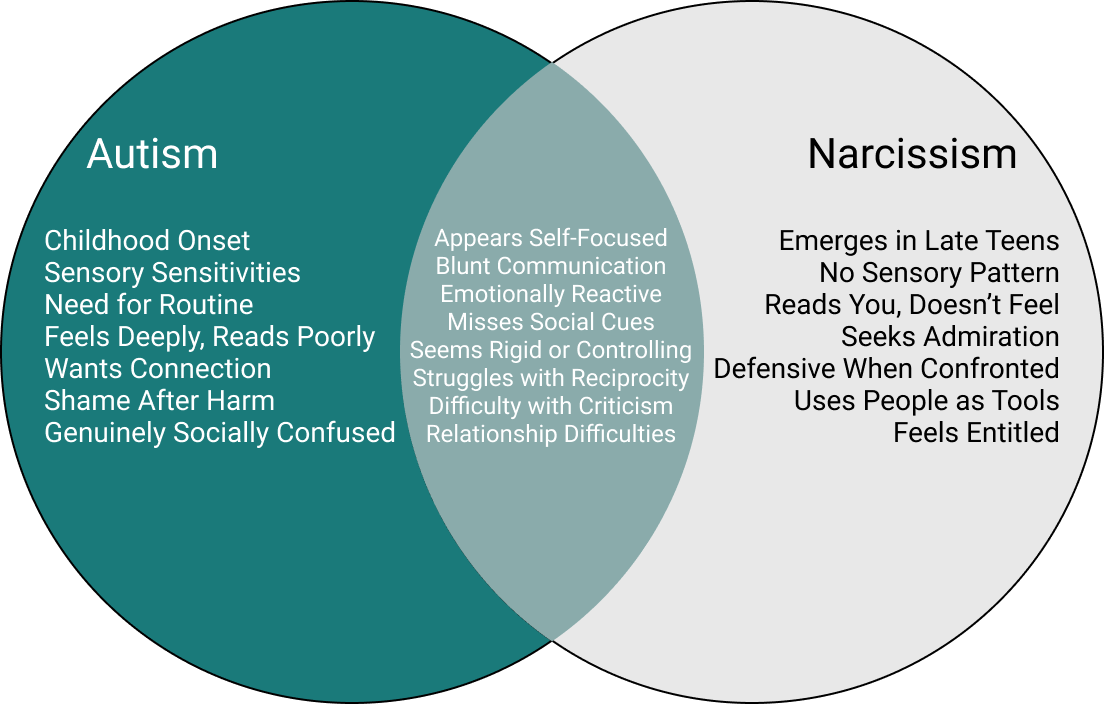 Autism and Narcissism Shared Symptoms and differences VENN diagram
If you’re trying to work out whether someone in your life is autistic or narcissistic, certain patterns are more informative than others.
Look at the developmental history. Autism is present from childhood. If someone struggled socially from their earliest years, was described as “odd” or “intense” by teachers, had niche obsessions, experienced bullying for being different, got lost in their own world: these are red flags for autism. Narcissistic personality disorder consolidates in adolescence or early adulthood. There’s usually no history of the sensory sensitivities, repetitive behaviours, or early social confusion that characterise autism.
Consider what happens when harm is named. In the therapy room, this is often the biggest differentiator. When an autistic client learns they’ve hurt someone, they’re usually visibly distressed, sometimes ruminating and thinking about it for days. They may even try to repair, even if clumsily. When a client with narcissistic traits hears the same feedback, the focus tends to stay on their own image, and the defensiveness comes first. Curiosity about anyone else’s experience rarely follows.
Notice what drives the behaviour. Autistic social difficulties stem from genuine confusion about the unwritten rules. The person wants connection but doesn’t know how to achieve it in expected ways. They’re often lonely, often exhausted from trying to fit in, often deeply ashamed of their differences. Narcissistic behaviour is driven by a need to maintain self-esteem and superiority. Relationships exist to provide admiration, status, or supply. The person may not particularly want connection beyond what it offers them.
Assess the sensory and routine picture. Autism involves sensory processing differences: strong reactions to light, sound, texture, movement. It involves a need for routine and predictability that goes beyond mere preference. Shutdowns and meltdowns occur in response to overwhelm, not specifically in response to criticism or ego threat. Executive dysfunction is common, creating genuine difficulty with task initiation that has nothing to do with entitlement. NPD has no sensory component. There’s no pattern of restricted, repetitive behaviours. Emotional storms tend to occur when self-image is threatened, not when the environment becomes overwhelming.
| Domain | Autism | Narcissism |
| Onset | Childhood, lifelong pattern | Adolescence/early adulthood |
| Core drive | Desire for connection, often confused about how to achieve it | Need to maintain self-esteem and superiority |
| Empathy pattern | Intact affective empathy, weaker cognitive empathy | Preserved cognitive empathy, reduced affective empathy |
| Response to causing harm | Confusion, then distress, often attempts to repair | Defensiveness, minimisation, or blame-shifting |
| Sensory profile | Hyper- or hypo-sensitivities, sensory overwhelm common | No sensory component |
| Social mistakes | Unintentional, followed by shame or rumination | Often serve entitlement, control, or self-protection |
| Self-esteem | Often chronically low, “I’m broken” shame | Fluctuates between grandiosity and collapse |
Can Someone Be Both Autistic and Narcissistic?
This question comes up often, and the honest answer is: rarely, but possibly.
What the Comorbidity Data Shows
As noted above, true comorbidity rates appear to be low. Most studies find that autistic adults do not meet criteria for narcissistic personality disorder, and most people with NPD do not have autism. These are distinct developmental pathways.
The 0% to 6.4% range for NPD in autistic populations comes from multiple studies, including work by Strunz and colleagues, Anckarsäter, and Lugnegård. By contrast, Cluster A and Cluster C personality disorders appear at much higher rates (40% to 60%) in autistic populations, suggesting that the low NPD overlap is meaningful rather than a measurement artefact.
The Vulnerable Narcissism Overlap
Autistic adults do show elevated rates of vulnerable narcissistic traits on research measures. This subtype of narcissism involves shame-proneness, emotional sensitivity, withdrawal, and a fragile sense of self, rather than the grandiosity and entitlement of classic narcissism.
The overlap makes sense: both presentations can involve emotional dysregulation, social avoidance, and hypersensitivity to perceived rejection. An autistic person’s elevated score on a vulnerable narcissism scale may not indicate true personality pathology. It may reflect the shame accumulated from a lifetime of social exclusion, the emotional volatility that comes with sensory overwhelm, or the withdrawal that results from chronic masking.
How to Think About This Clinically
If you’re wondering whether someone in your life has both conditions, the question to ask is whether there’s a pattern of exploitation, manipulation, and strategic disregard for others’ wellbeing. These are the features that distinguish personality pathology from neurodevelopmental differences.
An autistic person with elevated vulnerable narcissistic traits is usually not exploiting anyone. A person with NPD, whether autistic or not, typically is.
Why Autistic Women Are More Likely to Be Mislabelled
Women and those assigned female at birth receive autism diagnoses later than men, if they receive them at all. Part of this delay involves misdiagnosis with other conditions, including personality disorders.
The Irish Context
In Ireland, about three times more boys are diagnosed with autism than girls, according to a 2018 review by the Department of Health. But researchers and clinicians increasingly believe this ratio reflects diagnostic bias rather than true prevalence.
A 2017 Irish study by Rabbitte, Prendeville, and Kinsella examined parents’ experiences of getting their daughters diagnosed with autism. They found that girls were often initially misdiagnosed with other conditions, including mood disorders and oppositional defiant disorder, before autism was eventually recognised. As speech and language therapist Elaine McGreevy noted at a seminar organised by the Psychological Society of Ireland, these other labels often “fall away when they are given an autistic identity.”
A UCD study published in 2020 by Fowler and O’Connor found that “the path of autism in girls in Ireland is marked by diagnostic delays, social stigma, interpersonal difficulties, mental health comorbidities and parental stress.” Every mother in the study reported their daughter experiencing debilitating anxiety.
Psychologist Davida Hartman, co-director of The Children’s Clinic in Sandycove, has spoken about the empathy myth that contributes to delayed diagnosis: “There is a myth or misconception that autistic people lack empathy. But this is just that, a myth. The autistic girls, and boys, that I know are generally extremely sensitive, in fact experiencing an over-empathy, which is very difficult for them to cope with day to day.”
The Masking Factor
Autistic women tend to develop sophisticated masking strategies from an early age. They learn to camouflage their differences, mimic neurotypical social behaviour, and suppress visible signs of autism in public. This masking often collapses in private, leading to burnout, mood instability, and intense emotional dysregulation that clinicians may read through a personality disorder lens.
The team at The Private Therapy Clinic often see women in their 30s and 40s who’ve been informally labelled narcissistic or narcissists by their partners or family members, only to discover through an assessment that they’re autistic and have gotten good at camouflage and have been masking for decades. The exhaustion of maintaining a public self (that is different from the private self) eventually collapses, and what emerges can seem like volatility and self-absorption, though it’s usually neither.
Kirsten Hurley, lecturer in autism studies at University College Cork, was diagnosed at 22 and has spoken about how masking affects wellbeing. “The research would indicate that it has a huge impact on someone’s wellbeing,” she told The Irish Times. “Some people have described it as a social hangover. They are exhausted from it and need to recover.”
The Consequences of Getting It Wrong
Research has documented the harm this causes. Autistic women misdiagnosed with personality disorders describe having their authentic distress pathologised, their requests for accommodation treated as manipulation, and their entire way of being framed as a problem to be fixed rather than a difference to be understood. The diagnostic label shapes how professionals respond to them, and not in helpful ways.
If you’re a woman who’s been labelled as having narcissistic traits and you recognise yourself in descriptions of autism, particularly high-functioning autism in women or the experience of masking, it may be worth seeking a formal autism assessment from a clinician who understands how autism presents differently across genders.
What This Means for Your Relationship
The distinction between autism and narcissism matters because the path forward is so different.
If Someone Is Autistic
The relationship can often improve through mutual understanding, clear communication, and accommodation of neurological differences. Autistic people can learn to express care in ways their partners recognise. Partners can learn to state their needs directly rather than expecting them to be inferred. Conflict often stems from misunderstanding rather than malice, and misunderstanding can be addressed.
If Someone Has NPD
The dynamic is fundamentally different. Narcissistic behaviour is not a communication problem that can be solved with better scripts. The exploitation, the need for control, the absence of genuine care for your wellbeing: these are not misunderstandings. Understanding how narcissism operates can help you recognise patterns, but many people find that the only way to protect themselves from a narcissistic relationship is to leave it.
The Cost of Getting It Wrong
Getting this distinction wrong causes harm in both directions. Treating an autistic person as if they’re narcissistic means pathologising their neurology, pressuring them to change things they cannot change, and often destroying their sense of self in the process. Treating a narcissist as if they’re just “socially awkward” means staying in a harmful dynamic and continually excusing behaviour that is genuinely exploitative.
If you’re uncertain, formal assessment can help. It can also help to work with a therapist who understands both presentations and can help you make sense of what you’re experiencing in the relationship. For guidance on navigating relationships where autism is a factor, our article on high-functioning autism and relationships may be useful.
For Autistic People Who’ve Been Called Narcissistic
If you’ve landed on this page because someone has called you selfish, entitled, or narcissistic, and you suspect you might be autistic, this section is for you.
The Pain of Being Mislabelled
Being mislabelled hurts. It’s disorienting to be told that your struggles are actually moral failings, that your differences make you a bad person, that the reason relationships are hard is because you don’t care about anyone but yourself.
The research suggests otherwise. Autistic people, on average, have intact affective empathy. Many have more than average. The difficulty is in reading situations, not in caring about them. The difficulty is in translating care into actions that others recognise as care. These are skill gaps, not character deficits.
What Assessment Can Offer
If you’ve spent your life feeling like you’re somehow doing relationships wrong without understanding why, if you’ve been called cold or selfish despite feeling things intensely, if you’ve worked harder than everyone around you just to appear normal and still somehow failed: these are common autistic experiences. They don’t make you a narcissist. They make you someone whose neurology doesn’t match the social environment you’re trying to navigate.
A formal assessment can provide clarity. It won’t solve every problem, but it can reframe a lifetime of confusion. Many autistic adults describe diagnosis as the moment when everything finally made sense, when shame started to lift, when they could stop blaming themselves for struggling with things that were never designed for their neurotype. If you suspect you might have mild or borderline autism, assessment can help you understand where your difficulties come from.
You might also find it useful to understand the overlap between autism and ADHD if some of your traits sit across both presentations, or to explore how ADHD can also be confused with narcissism for different but related reasons.
Voices From The Community
The following examples reflect personal experiences shared in online communities. They are not diagnostic and do not imply that autism causes narcissism, but they do illustrate why the two are so often confused in everyday life. These quotes are drawn from Reddit forums such as r/autism, r/AutisticAdults, and r/aspergirls, and are lightly paraphrased to protect privacy:
“You just don’t care about anyone but yourself.”
One autistic woman described hearing this throughout her life. “I cared so much it was overwhelming. I just didn’t know how to show it in the way people expected. I’d go quiet when someone was upset because I was flooded, not because I didn’t feel anything. But they read it as coldness.” — r/autism
“I genuinely believed I was a narcissist.”
A man diagnosed with autism in his early forties described years of confusion. “I’d read about narcissism and think, that must be me. I talked too much about my interests. I missed cues. People said I was selfish. It wasn’t until the autism assessment that I realised I wasn’t manipulating anyone. I just wasn’t picking up what they weren’t saying out loud.” — r/AutisticAdults
“The difference was what happened when I told him he’d hurt me.”
One woman described realising her partner was narcissistic, not autistic, after initially assuming the opposite. “When I said something had upset me, he didn’t get confused or ask questions. He got defensive. He turned it around so I was the problem. An autistic person might not understand why you’re hurt, but they usually want to. He didn’t want to. He wanted to win.” — r/AutismInWomen
“I grew up with a narcissistic parent. When I was diagnosed autistic, everything made sense.”
Several people in online forums described a pattern of growing up with a narcissistic caregiver and later discovering their own autism. “I’d learned to mask so hard because any mistake was punished. I thought my struggles were just damage from her. Turns out I was also autistic, and I’d spent my whole life hiding it to survive.” — r/AutisticAdults
These voices underline a central theme: autistic people are often labelled cold, selfish, or narcissistic when they are, in many cases, feeling deeply but struggling to express it in ways others recognise.
When to Seek Help and Next Steps
If you’re trying to understand whether you or someone in your life might be autistic, we offer comprehensive autism assessments for adults at our Ireland clinic. Since the HSE does not currently provide adult autism assessments, private assessment is often the only route to diagnosis. Our clinicians are experienced in identifying autism across different presentations, including the subtler forms that are often missed or misdiagnosed in women and high-masking individuals.
We also offer therapy for those navigating difficult relationships, whether you’re recovering from narcissistic abuse or trying to build better communication in a neurodiverse partnership.
If you’re unsure where to start, you can book a free 15-minute consultation to talk through your concerns and find out what support might be most helpful.