If you’ve always found reading harder than it should be, but your autism diagnosis didn’t quite explain everything, you might be dealing with more than one condition.
You can read. You’ve always been able to read. But something about it has never felt right.
Maybe words swim on the page when you’re tired. Maybe you read the same paragraph three times before it sinks in. Maybe you’ve developed elaborate systems to avoid reading aloud, or you’ve noticed that your spelling has always been inconsistent in ways that don’t match how intelligent you know yourself to be.
If you’re autistic and this sounds familiar, there’s a reasonable chance you also have dyslexia. And there’s an equally reasonable chance that nobody ever thought to check. A dyslexia assessment can clarify whether your reading difficulties stem from a separate condition that requires its own support.
Research suggests that somewhere between 10 and 30 percent of autistic people also meet criteria for dyslexia. That’s significantly higher than the general population rate of around 5 to 10 percent. Yet dyslexia in autistic adults often goes unrecognised for years, sometimes decades, because clinicians and educators focus on the autism and assume it explains everything.
This matters because the support strategies for each condition are different. Understanding which difficulties come from where changes what actually helps.
What is Dyslexia?
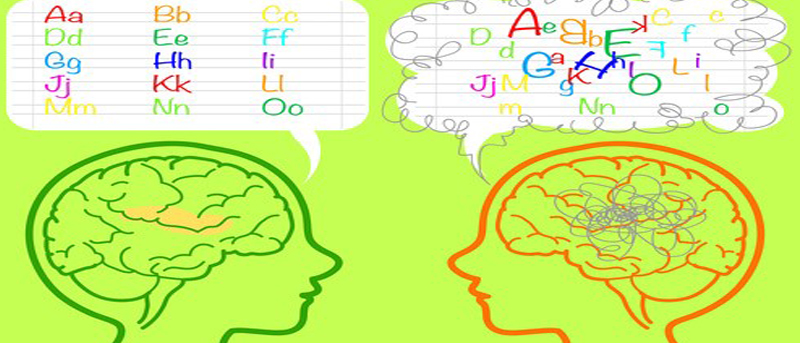
Dyslexia is a specific learning difference that affects how the brain processes written language. The core difficulty lies in phonological processing, which is the ability to break words down into their component sounds and map those sounds onto letters.
This shows up as difficulty with decoding unfamiliar words, inconsistent spelling, slow or effortful reading, and problems with reading aloud. None of this has anything to do with intelligence. Many people with dyslexia have average or above-average IQ, and the condition often coexists with genuine strengths in areas like creative thinking, problem-solving, and visual-spatial reasoning.
A 2020 review by Snowling, Hulme, and Nation traced how our understanding of dyslexia has evolved over decades of research, confirming that the condition is best understood as a persistent difficulty with accurate and fluent word reading rooted in phonological deficits. The review also highlighted that dyslexia rarely occurs in isolation, frequently appearing alongside other neurodevelopmental conditions including ADHD and, notably, autism.
Dyslexia affects roughly one in ten people, though estimates vary depending on how strictly the condition is defined. It runs in families and is present from birth, though it often isn’t identified until school-age when reading demands increase.
Is Dyslexia a Form of Autism?
This is a common question, and the short answer is no. Dyslexia and autism are distinct conditions with different core features, different neurological profiles, and different diagnostic criteria. You can have one without the other.
That said, they co-occur more often than chance would predict. The link between autism and dyslexia appears to involve some shared genetic and neurological pathways, particularly around executive function and processing speed. But having dyslexia doesn’t mean you’re “on the spectrum,” and being autistic doesn’t automatically mean you have dyslexia.
The confusion sometimes arises because both conditions can affect language and communication, and both fall under the broad umbrella of neurodevelopmental differences. But the mechanisms are distinct, and so are the interventions that help.
Why Estimates of Dyslexia and Autism Co-occurrence Vary
If you’ve looked into this before, you may have encountered wildly different statistics. Some sources claim up to 50 percent of autistic people have dyslexia. Others suggest there’s no increased risk at all. The truth sits somewhere in between, and the variation tells us something important about how both conditions are understood and measured.
A 2009 study by Hofvander and colleagues assessed 122 adults with autism across three European centres and found that approximately 14 percent met criteria for a reading or written expression disorder. Broader reviews, such as those by Russell and Pavelka in 2013, suggest the figure rises to 20 to 30 percent when “reading difficulties associated with dyslexia” are counted rather than strictly diagnosed dyslexia alone.
The variation comes down to definitions and methods. Some studies use narrow diagnostic criteria for dyslexia. Others include any significant reading delay identified by schools. Some recruit from clinics where people are more likely to have complex presentations. Others draw from population samples. Cut-off points for what counts as “impaired” differ between studies and between countries.
For practical purposes, the most defensible statement is this: autistic people are more likely to have dyslexia than the general population, with estimates typically falling in the 10 to 30 percent range depending on how both conditions are measured.
Why Dyslexia Gets Missed in Autistic Adults
There’s a phenomenon in clinical practice called diagnostic overshadowing. Once someone receives a diagnosis, particularly a significant one like autism, there’s a tendency to attribute all subsequent difficulties to that diagnosis. Everything gets folded into the same explanation.
This happens with dyslexia and autism more than it should. Reading comprehension problems get attributed to “autistic language style” rather than phonological deficits. Spelling inconsistencies are written off as unimportant. Schools focus on social and behavioural support and don’t think to screen for specific learning differences.
Dyslexia can be missed in autistic children too, particularly when hyperlexia or strong visual memory masks underlying phonological weaknesses. But adults face additional barriers. Years of developing workarounds, combined with the assumption that any reading issues would have been picked up in school, mean that late identification is common.
A 2022 study by Mandy and colleagues examined the experiences of late-diagnosed autistic adults and found that many had accumulated years of alternative psychiatric labels and unrecognised neurodevelopmental needs before finally receiving accurate diagnoses. While the study focused primarily on autism, anxiety, and depression, the pattern it describes applies equally to dyslexia: when one condition dominates clinical attention, others slip through.
Historical Diagnostic Rules
The problem is compounded by how diagnostic systems used to work. For years, official classification systems treated autism as an exclusion criterion for dyslexia. If you had autism, you couldn’t also have dyslexia by definition. This rule has since been dropped, but its effects linger in clinical practice and in the memories of adults who were assessed under the old system.
Service Silos
There are also structural issues. Autism diagnostic pathways typically sit within mental health or developmental services. Dyslexia identification often happens through education systems. Adults who seek assessment privately may find themselves navigating two completely separate processes with professionals who don’t routinely communicate with each other.
Masking and Compensation
Some autistic people develop strong visual memory and rule-based decoding strategies that camouflage underlying phonological weaknesses. They can read accurately, but only at significant cost in terms of time and mental effort. This compensation works well enough to avoid detection, particularly in high-functioning autism presentations where academic achievement may be high overall.
The result is that many autistic adults with genuine dyslexia have spent their lives compensating without knowing why reading felt so much harder than it seemed to for everyone else.
How Autism and Dyslexia Overlap
Both conditions are neurodevelopmental, meaning they affect brain development from early life and persist throughout adulthood. Both are highly heritable. Both can affect language processing, though in different ways.
Shared Features
The common ground includes some overlap in executive function difficulties, particularly around working memory and processing speed. Both conditions can involve sensory sensitivities. Both are associated with anxiety, often as a secondary consequence of years of struggling in systems designed for neurotypical brains.
Research by Frith, published in 2013 following 25 years of studying both conditions, emphasises that each sits on a continuum with enormous individual variability. The same person might have mild dyslexia and significant autism, or the reverse, or roughly equal presentations of both.
Genetic Links
There’s evidence of shared genetic risk between autism and dyslexia. A 2020 genome-wide association study by Gialluisi and colleagues found that dyslexia shares some common genetic variants with other neurodevelopmental conditions, though the overlap with autism specifically is modest. The findings suggest that shared risk is likely mediated through general cognitive and attention pathways rather than a single gene affecting both conditions directly.
This genetic overlap extends to ADHD as well, which is why all three conditions frequently appear together.
How Dyslexia and Autism Differ
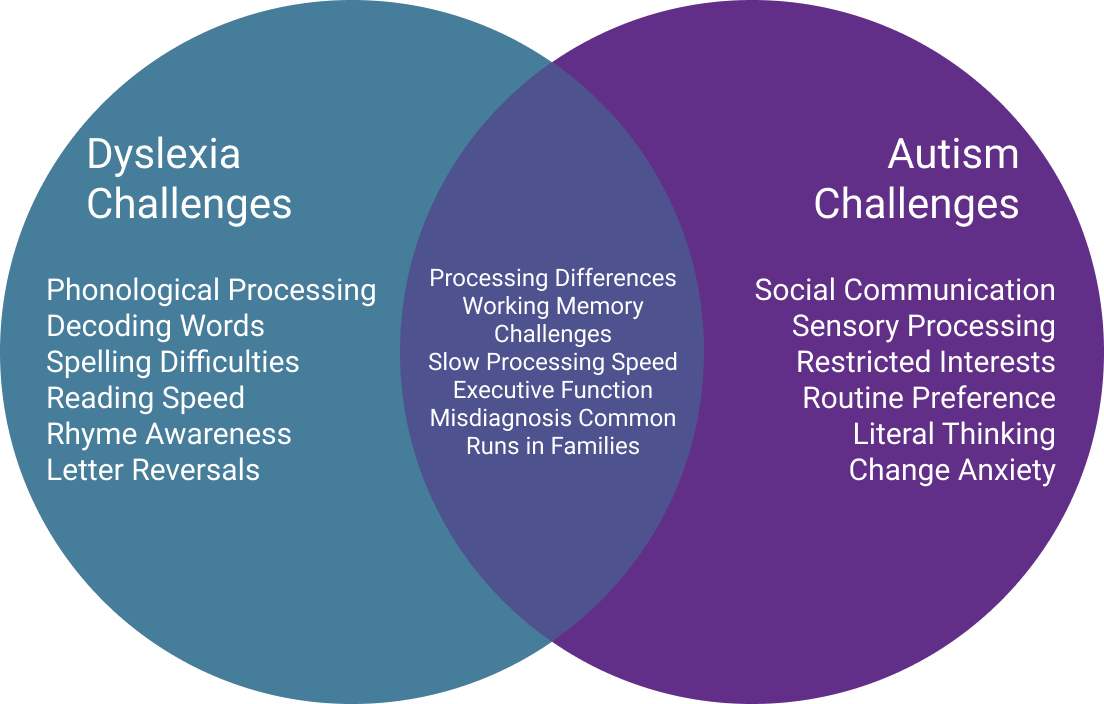 Key processing overlaps between dyslexia and autism
The core distinction matters for understanding your own experience and for getting appropriate support. The following table summarises the key differences in how reading difficulties typically present:
| Feature | Dyslexia | Autism-Related Reading Difficulties |
| Core difficulty | Phonological processing (mapping sounds to letters) | Comprehension, inference, social content |
| Word-level reading | Slow, effortful, often inaccurate | Often intact or even advanced |
| Spelling | Inconsistent, reflects sound confusion | May be accurate or reflect rigid rule-following |
| Reading speed | Slow even with familiar content | Variable depending on interest and fatigue |
| Comprehension | Often good once text is decoded | Difficulty with inference, non-literal language, subtext |
| Reading aloud | Difficult, avoided | May be fluent but lack prosody |
When someone has both conditions, you typically see both patterns: word-level difficulties with decoding and spelling alongside comprehension challenges with inference and social content. Neither condition fully explains the picture.
Hyperlexia: The Opposite Pattern
This distinction also appears in the phenomenon of hyperlexia, which is sometimes seen in autistic children. Hyperlexic readers decode precociously, often teaching themselves to read at very young ages, but may struggle significantly with comprehension. This pattern, strong decoding with weak comprehension, is essentially the opposite of classic dyslexia and illustrates how reading difficulties in autism can take very different forms.
Signs You Might Have Both Conditions
Consider someone who received an autism diagnosis in their thirties after years of anxiety treatment that never quite addressed the underlying issues. They’ve always been a “slow reader.” They avoid books, struggle with long emails at work, and have quiet workarounds for situations where they might need to read aloud. They assumed this was just part of being autistic.
It might be. Autistic people often process written information differently, preferring to take their time, re-reading for precision, or finding that fatigue and sensory overload affect reading stamina.
But it might also be dyslexia. The clues that suggest a separate reading disorder include:
- Consistent difficulty with nonword reading (sounding out made-up words like “phlonk” or “graith”)
- Spelling errors that reflect phonological confusion rather than typos
- Slow reading even when the content is familiar and engaging
- A history of avoiding reading aloud, even in low-pressure situations
- Family history of reading difficulties or diagnosed dyslexia
The presence of several of these signs, particularly the nonword reading difficulty, suggests that phonological processing problems may be contributing to your experience alongside any autism-related factors.
Dyslexia, ADHD, and Autism: The Triple Overlap
It’s worth noting that ADHD often enters the picture as well. The three conditions, autism, dyslexia, and ADHD, share some genetic risk factors and frequently co-occur. Research suggests that pleiotropy, where the same genes contribute to multiple traits, may explain some of this overlap.
If you’re autistic with suspected dyslexia and also struggle with attention, task initiation, or impulsivity, it may be worth considering whether ADHD is part of the picture. The combination creates its own distinctive challenges with reading and learning that require a tailored approach to support.
Why Getting a Dyslexia Assessment Matters
You might wonder whether formal identification makes any difference, particularly if you’ve already developed your own coping strategies over years of managing unrecognised difficulties.
Diagnosis can matter for several reasons. It opens access to workplace accommodations such as extra time for written tasks, assistive technology, or flexibility in how you’re expected to communicate. Under the Disability Act 2005, employers and educational institutions have obligations to provide reasonable accommodations once a diagnosis is in place. It provides language to explain difficulties to yourself and others. And it can bring relief: the recognition that reading has always felt harder because it was harder, not because you weren’t trying.
Perhaps most importantly, it can help clarify which strategies are likely to help. The approaches that work for autism-related comprehension difficulties differ from those that work for phonological processing problems. Understanding your own profile allows for more targeted support.
Getting Assessed for Dyslexia as an Autistic Adult in Ireland
In Ireland, dyslexia assessments for adults are typically conducted by educational psychologists or specialist assessors affiliated with organisations like Dyslexia Ireland. The HSE does not routinely provide these assessments for adults, so most people access them privately through clinics, through Dyslexia Ireland, or via independent psychologists.
If you’re pursuing assessment, look for a professional who has experience working with neurodivergent adults. Psychologists in Dublin, Cork, and other major centres increasingly specialise in this area. Mention your autism diagnosis upfront. A skilled assessor will understand how autism might affect test performance and will interpret results in context.
The assessment usually takes two to three hours and involves a range of reading, spelling, writing, and cognitive tests. You’ll receive a detailed report explaining your profile, including any discrepancies between your abilities in different areas, and recommendations for support and accommodations.
How The Private Therapy Clinic Can Help
If you’re an autistic adult who suspects you may also have dyslexia, we can help you understand what’s going on and what to do about it. The Private Therapy Clinic Ireland offers comprehensive dyslexia assessments conducted by specialists who understand neurodevelopmental conditions in adults. We also provide autism assessments for those who haven’t yet received a diagnosis but recognise themselves in this article. If you’re unsure where to start, you can book a free 15-minute consultation to talk through your situation and explore your options.